


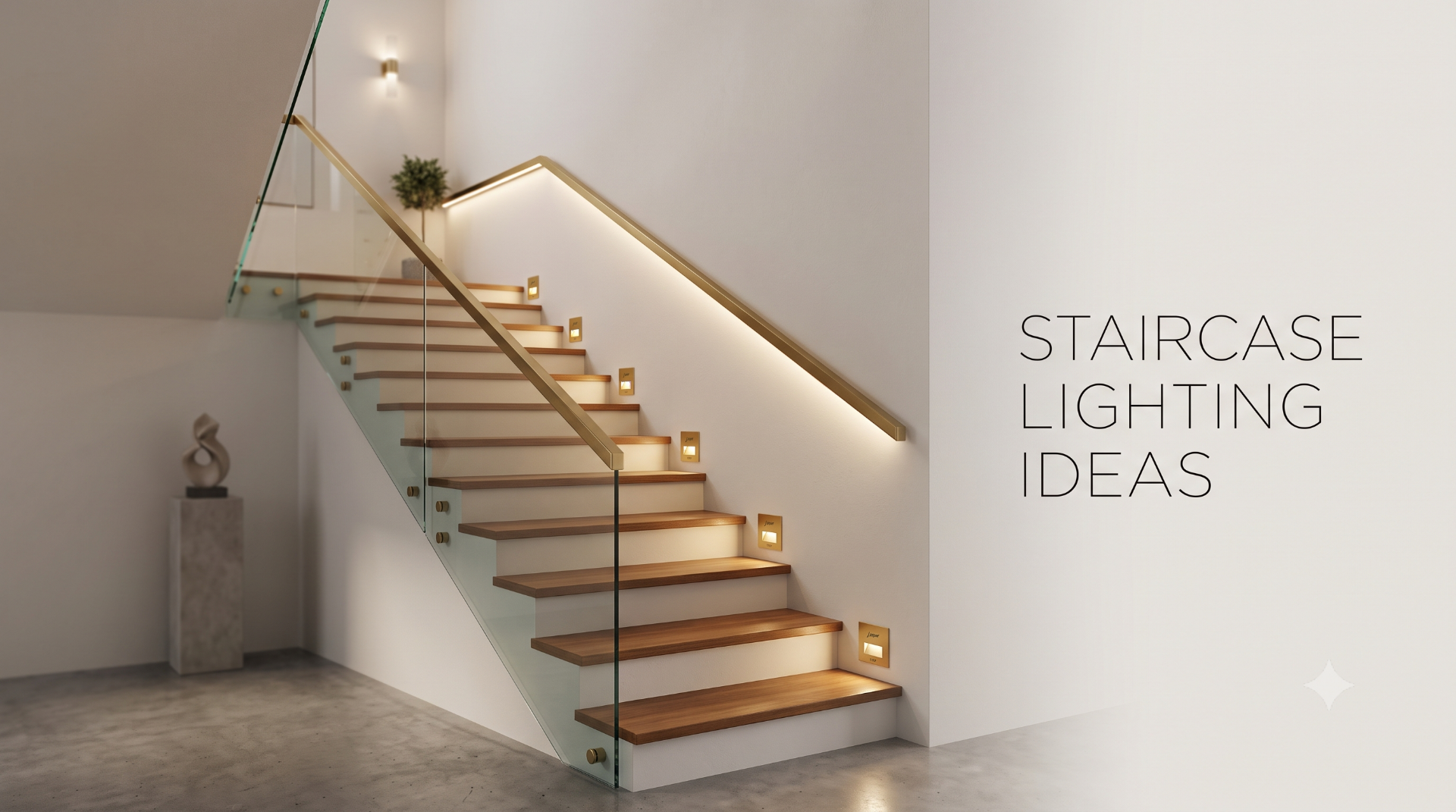
Staircases are often designed around their shape, materials and proportions, while lighting is considered only once the rest of the interior is complete. That approach can leave one of the home's most frequently used transition spaces dependent on a single ceiling light.
A better approach is to treat the staircase as its own lighting zone.
The right lighting can make individual steps easier to distinguish, soften a plain staircase wall, emphasise architectural lines and create a comfortable transition between floors. It can also change how the staircase feels at different times of day without requiring an elaborate installation.
Whether the staircase belongs to an apartment, house, duplex or larger residential space, the most successful solution is usually based on the architecture first and the fixture second.
This guide explains how to plan staircase lighting ideas around different staircase forms, lighting positions, materials and everyday use, while showing how stair lights can work alongside other lighting already present in the home.
Why Staircase Lighting Needs Special Attention
A staircase is not a flat surface.
It contains multiple horizontal and vertical planes, changes direction in some layouts and often receives different amounts of daylight along its length. A lighting arrangement that works beautifully in a living room may therefore be unsuitable for stairs.
Good stair lighting should make three things easy to understand:
- Where the next step begins.
- Where the staircase changes direction.
- Where the staircase starts and ends.
At the same time, the light should not create distracting glare.
Jaquar Sri Lanka has a dedicated stair-lighting category with LED Foot Light and Foot Light options, while its wider lighting portfolio includes wall, ceiling, decorative and indoor lighting.
That makes it possible to approach staircase lighting as part of a broader interior lighting plan.
1. Recessed Stair Lighting
Recessed lighting is a strong choice when a clean architectural appearance is important.
The fixture is integrated into the wall or staircase structure rather than projecting significantly into the room. This makes it particularly suitable for contemporary interiors where visual clutter needs to be kept under control.
Recessed stair lights work well when:
- The staircase has a solid wall.
- The wall can accommodate the required installation.
- A discreet appearance is preferred.
- The staircase forms part of an open living area.
- The lighting should remain visually secondary to the architecture.
Rather than trying to make the fixture noticeable, the aim is to make its effect noticeable.
The light should help reveal the steps while allowing the staircase materials, railing and surrounding architecture to remain the focus.
2. Use Foot Lights for Low-Level Illumination
Foot lights bring illumination closer to the stairs themselves.
This makes them useful for residential staircases where people may need to move through the space during the evening or at night without switching on the brightest lights in the surrounding rooms.
They are particularly useful when:
- The staircase is relatively long.
- The stairwell is enclosed.
- Natural light is limited.
- The stairs have dark finishes.
- The staircase connects bedrooms or private areas.
Jaquar Sri Lanka specifically lists LED Foot Light and Foot Light products under its stair-light category.
The most important design principle is consistency. If several fixtures are used, their relationship to the steps should feel deliberate and regular.
3. Use Wall Lamps to Add a Softer Layer
A staircase wall can often accommodate more than one function.
It can provide architectural enclosure, display artwork or decorative elements and act as a surface onto which light can be directed.
Wall lamps are useful in this situation because they can contribute both illumination and visual character.
They are particularly appropriate for:
- Staircases opening into living rooms
- Entrance staircases
- Feature walls
- Staircases with generous wall space
- Homes where decorative lighting is already part of the interior
Jaquar Sri Lanka's wall-light portfolio includes multiple wall-lamp designs and finishes.
The positioning matters. A wall light should provide useful illumination without creating direct glare for people moving up or down the stairs.
4. Combine Stair Lights With Ceiling Lighting
A staircase rarely needs to rely on a single type of lighting.
Ceiling lighting can provide broad illumination, while stair or foot lights can define the individual steps.
This creates a layered approach:
Ambient lighting → illuminates the overall staircase
Low-level lighting → defines the steps
Decorative lighting → adds character where appropriate
This is generally more effective than increasing the brightness of one fixture until it is expected to solve every lighting requirement.
Jaquar Sri Lanka's ceiling-light range includes pendant and ceiling-light options that can contribute to the broader lighting composition of a home.
5. Staircase Lighting for a Small Home
Small homes benefit from lighting that does not consume visual space.
Large decorative fixtures can sometimes make a narrow staircase feel even tighter. In such situations, discreet stair or wall lighting can provide the required illumination without competing with the architecture.
A practical approach is to:
- Keep fixtures compact.
- Use the wall surface intelligently.
- Avoid excessive brightness.
- Maintain consistent spacing.
- Coordinate the staircase lighting with nearby rooms.
If the staircase opens directly into a living room, the lighting should also feel like an extension of that space rather than a separate installation.
6. Lighting a Wide Staircase
A wider staircase provides more opportunities for visual layering.
Depending on the architecture, the staircase may accommodate dedicated step lighting combined with wall or ceiling illumination.
The wider the staircase, however, the more important light distribution becomes.
Avoid a situation where the centre of the staircase is bright but its edges fall into shadow.
Look at the staircase from the point of view of someone approaching it. The entire width should feel visually readable rather than illuminated only along one narrow path.
7. Open Staircases Need Careful Glare Control
Open staircases are visually lighter because the space beneath and around the treads remains visible.
That openness makes lighting particularly important.
A poorly positioned light can become visible from multiple angles, creating glare or reflections on glass and polished surfaces.
For an open staircase, consider where the light will be seen from:
- Bottom of the stairs
- Top of the stairs
- Adjacent living area
- Landing
- Side corridors
The light source should ideally remain discreet while the illuminated surface remains visible.
8. Lighting L-Shaped and U-Shaped Staircases
A change in direction creates a natural lighting zone.
The landing between two flights should not become an accidental dark spot.
Think of the staircase as a sequence:
First flight → landing → second flight
Each section should transition naturally into the next.
If the landing contains a wall, a wall lamp may help create continuity. If there is a ceiling above the landing, a ceiling or downlight can provide general illumination.
The objective is simple: when someone reaches the corner, the next section of the staircase should already be visually clear.
9. Use Lighting to Bring Out Staircase Materials
Lighting can change how materials appear.
A textured wall can become more visually pronounced when light grazes across its surface. A wooden handrail may appear warmer under softer illumination. Light-coloured walls can distribute illumination more widely, while darker finishes can absorb more of it.
Consider the relationship between lighting and:
- Wood
- Stone
- Ceramic surfaces
- Painted walls
- Glass
- Metal railings
- Dark flooring
The fixture should support these materials rather than fight them.
This is why selecting the light only from a product image is rarely enough. The surrounding surfaces matter just as much.
10. Stair Lighting and Natural Daylight
A staircase that receives strong daylight during the day may require very little artificial illumination until evening.
That does not mean the staircase should be designed without considering artificial lighting.
Instead, plan the artificial layer around the period when natural light begins to disappear.
This can be particularly useful for staircases near windows, open landings or double-height areas.
A good design should feel appropriate in both conditions:
Day: the fixtures remain visually discreet.
Evening: the lighting gradually becomes part of the interior atmosphere.
11. Warm, Neutral or Cool Light?
Colour temperature should be considered in relation to the surrounding home.
Warm lighting tends to create a softer residential atmosphere and can work well with timber, warm neutral walls and relaxed interiors.
Neutral light provides a balanced appearance and can be suitable when the staircase needs clear, natural-looking illumination.
Cooler light creates a crisper visual character and may suit contemporary interiors that already use cooler tones.
There is no single correct answer for every staircase. Consistency is more important than following a trend.
If the adjoining living space uses warm lighting, suddenly introducing noticeably cooler lighting on the staircase can make the transition feel visually disconnected.
12. Staircase Lighting in Apartments
Apartment staircases often have less architectural freedom than large standalone homes.
There may be limited ceiling height, narrower walls or restrictions on structural modifications.
In these situations, focus on solutions that make the most of the available surfaces.
A low-profile stair light can help illuminate the steps without occupying valuable wall space. Wall lighting can work where there is sufficient clearance. Ceiling lighting can provide general illumination where recessed installation is possible.
The right solution is the one that works with the existing structure rather than forcing the architecture to accommodate an unsuitable fixture.
13. Staircase Lighting in Larger Homes
Larger homes may have more dramatic staircases, wider landings or open connections between floors.
Here, lighting can become part of the home's architectural language.
A staircase may be visible from:
- The entrance
- Living room
- Dining area
- Upper landing
- Multiple rooms
That means the fixture selection should be considered from several viewpoints.
The staircase should look balanced even when viewed from a distance.
This is where combining dedicated stair lighting with carefully selected decorative or ceiling lighting can create a more cohesive result.
14. Don't Over-Light the Staircase
One of the most common mistakes is treating brightness as the primary measure of success.
A staircase can be safe and comfortable without being the brightest area of the home.
Too much light can create glare, flatten the appearance of materials and make adjacent rooms feel comparatively dark.
Instead, focus on contrast and visual hierarchy.
The steps should be easy to identify. The surrounding walls should provide enough context. The light source itself should not become a distraction.
15. Coordinate Stair Lighting With the Landing
The upper and lower landing areas deserve attention because they connect the staircase to the rest of the home.
If the staircase is beautifully illuminated but the landing immediately above it is significantly darker, the transition can feel incomplete.
The same applies at the bottom.
Try to maintain a logical progression:
Room → landing → stairs → landing → room
This creates a more natural visual experience and prevents the staircase from appearing like an isolated lighting zone.
16. Practical Maintenance
Stair lighting is generally easy to overlook because fixtures may be positioned low on walls or integrated into architectural surfaces.
Regularly check that:
- Light covers remain clean.
- Dust is not affecting illumination.
- Fixtures are securely positioned.
- Outdoor or exposed fixtures remain clear of debris where applicable.
- Damaged fittings are addressed promptly.
Keeping the lighting clean is particularly important for low-level fixtures because dust is more noticeable close to the floor.
Common Staircase Lighting Mistakes
Choosing fixtures without considering the staircase
A fixture that works beautifully in one setting may not suit another.
Creating bright spots and dark gaps
Uneven spacing can make a staircase visually inconsistent.
Ignoring glare
The light source should not be directly in the line of sight.
Forgetting the landing
Directional changes need illumination too.
Mixing unrelated lighting styles
The staircase should connect visually with nearby rooms.
Installing decorative lighting where functional lighting is required
A decorative fixture should complement visibility, not replace it.
A Simple Selection Framework
Before selecting your fixtures, answer five questions:
- What type of staircase do I have?
Straight, L-shaped, U-shaped, open-riser or another configuration? - Where can the light be installed?
Wall, riser, ceiling or another available surface? - How much natural light reaches the staircase?
This determines how important artificial lighting becomes during the day. - How is the staircase used at night?
Frequent movement may justify dedicated low-level lighting. - What lighting already exists nearby?
The staircase should complement the surrounding lighting rather than conflict with it.
Frequently Asked Questions
1. What type of light is best for stairs?
Dedicated stair lights and foot lights are particularly useful because they provide illumination close to the steps. Wall and ceiling lighting can complement them depending on the staircase structure.
2. Do staircase lights improve visibility?
Yes. Properly positioned lighting can make individual steps, landings and changes in direction easier to see, particularly after natural daylight decreases.
3. Should staircase lights be warm or cool?
Either can work. The decision should depend on the surrounding lighting, interior finishes and the atmosphere you want to create. Consistency across connected spaces is important.
4. Can wall lights be used on a staircase?
Yes. Wall lights can provide useful side illumination while also adding a decorative layer, provided they are positioned to avoid glare and obstruction.
5. How do I make a staircase look more attractive with lighting?
Focus on layering rather than simply adding more fixtures. Combine appropriate stair or foot lighting with existing ceiling or wall lighting, and use illumination to emphasise the staircase's materials and architecture.
Conclusion
The best staircase lighting is rarely about adding the largest number of fixtures. It is about understanding how people move through the space and then placing light exactly where it contributes to visibility, comfort and visual continuity.
Dedicated stair and foot lights can define the steps, while wall and ceiling lighting can connect the staircase to the rest of the interior. The final choice should reflect the staircase's shape, materials, natural light and surrounding décor.
Jaquar Sri Lanka's lighting portfolio includes dedicated stair-lighting products as well as wall, ceiling and decorative lighting, giving homeowners multiple formats to consider when creating a coordinated lighting scheme.
Choosing lighting from a coordinated portfolio can simplify the design process and help maintain consistency between functional and decorative fixtures. For a staircase, that balance allows the lighting to remain useful every day while becoming a natural part of the home's overall character.