


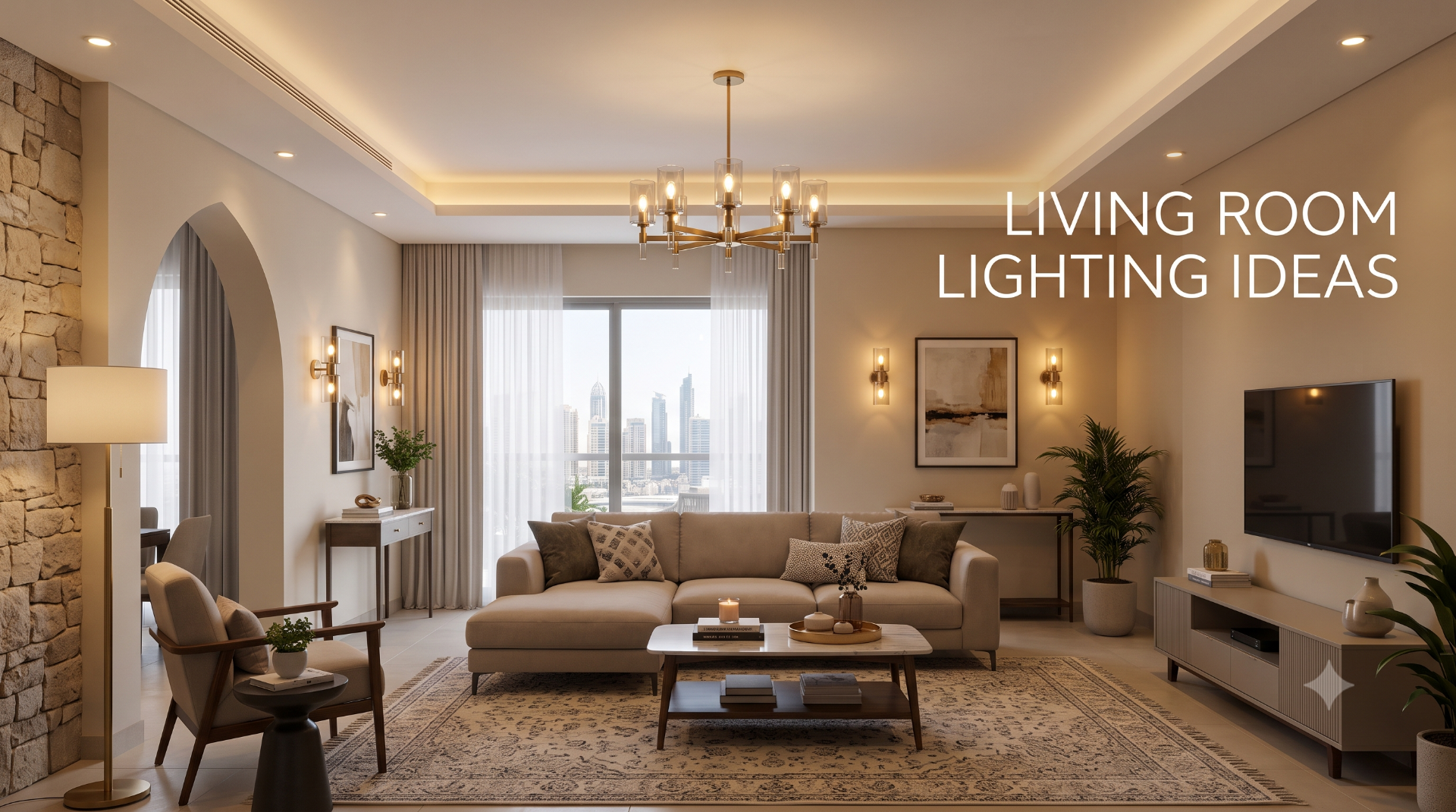
Anyone who has lived through a Sri Lankan monsoon knows the moment. At three in the afternoon the sky turns slate grey, rain drums on the roof, and a hall that was bright an hour ago suddenly feels like evening. Our homes are built for light and air, with wide verandahs, open plans, tall roofs and doors that stay open to the breeze. When daylight disappears, though, artificial light has to take over, and many homes still rely on a single tube light or one ceiling fitting that flattens everything.
The hall, as many families call it, is where Sri Lankan life gathers. It hosts visiting relatives, Avurudu celebrations, almsgivings, birthday parties, cricket on TV and quiet evenings with a cup of tea. These living room lighting ideas are shaped by that way of living and by the realities of a tropical climate. Each one explains why it works and how to get the details right, so you can plan with confidence whether you are building, renovating or simply upgrading.
Start With the Climate, Not the Catalogue
Three conditions set Sri Lankan homes apart, and all of them affect lighting choices.
Humidity. Coastal homes in Colombo, Galle, Negombo and Trincomalee deal with moist, salty air for much of the year. Fittings near open doors and verandahs need an appropriate IP rating, and quality finishes resist corrosion far better than cheap alternatives.
Insects. Open doors and evening light attract insects. Cool white and blue-rich light draws more of them than warm white, which is one more reason to favour warm tones in spaces that open to the garden.
Ceiling fans. Most halls have at least one fan, and it affects where lights can go. Light shining through moving blades creates a flickering, strobing shadow that is surprisingly tiring. Plan light positions and fan positions together.
Lighting the Everyday Hall
1. Replace the Single Central Light With Layers
For decades, the standard Sri Lankan hall was lit by one fluorescent tube or a single central fitting. It gave enough light to see by, but it made every corner equally bright, flattened furniture and faces, and left no way to change the mood. The most effective hall lighting ideas begin by replacing that single source with three layers, each doing its own job.
Ambient light provides general brightness for moving around and everyday life, around 100 to 200 lux. Task light supports focused activities such as reading, homework or sewing, at around 300 to 500 lux where it is needed. Accent light highlights features such as artwork, a textured wall or a display shelf, and should be roughly three times brighter than its surroundings to stand out.
To start, draw a simple plan of your hall and mark where people sit, where they walk and where the TV and main features are. Then decide which layer each area needs. A reading chair needs task light, the main wall may need accent light, and the whole room needs a gentle ambient base.
You do not have to do everything at once. Many families upgrade in stages: ambient light first, then wall lights and accents later. What matters is planning the wiring for all layers from the beginning, so later additions do not mean breaking walls or ceilings.
2. Plan Recessed Downlights Around Seating and Fans
In homes with a false ceiling, recessed downlights are the most common choice for general light. Choosing ceiling lights for living room use is not only about the fitting, though. Where you place them makes the biggest difference.
Start by placing downlights around the seating area and near the walls, not directly above people's heads. Light from straight above casts shadows under the eyes and feels harsh. Light falling slightly to the side is far more flattering and comfortable.
A useful spacing guideline is to keep fittings roughly as far apart as the ceiling is high, and about half that distance from the walls. On a 2.8 m ceiling, that means fittings about 2.8 m apart and 1.2 to 1.4 m from the walls.
The ceiling fan needs special attention. If a downlight sits above or just beside the fan's blade sweep, the blades chop the light and create a flickering shadow across the room. Keep downlights well outside the circle of the blades, ideally at least half a metre beyond their tips.
Deep-set, anti-glare downlights keep the light source out of view when family members relax on the sofa and look up. Jaquar's anti-glare downlights are a good example of fittings designed for that kind of long-evening comfort. Choose warm white for a relaxed atmosphere, and fittings rated for humid conditions if you live near the coast.
3. Use Surface-Mounted Fittings on Slab Ceilings
Many Sri Lankan houses, especially older homes and those built on a budget, have concrete slab ceilings without a false ceiling. Adding a false ceiling just to fit recessed lights lowers the room, adds cost, and in humid climates can create hidden spaces where moisture and pests collect. Surface-mounted lighting avoids all of this.
Slim surface-mounted downlights sit directly on the slab and give a clean, modern look. Round or square profiles in white blend into a white ceiling almost invisibly. Cylinder lights in black or metallic finishes create more of a design statement and suit contemporary interiors with dark joinery or exposed materials.
Some points to plan:
- Cable routing: Without a ceiling void, cables must run in surface conduit or be chased into the slab. Decide the light positions early so the electrician can route cables neatly.
- Alignment: Every surface fitting is visible, so line them up with walls, windows and the main furniture. Neat alignment makes the ceiling look intentional.
- Fan positions: On a slab ceiling, the fan and lights share the same surface, so plan both together. Keep fittings outside the fan's blade sweep to avoid flicker.
- Ventilation: Quality surface fittings are designed to dissipate heat without a void, which helps them last in warm conditions.
Surface-mounted track systems are another good option for slab ceilings, combining the simplicity of direct fixing with adjustable spotlights.
4. Light Timber Ceilings and Exposed Beams
Homes influenced by tropical modernism, the style the architect Geoffrey Bawa made famous, often feature sloping timber roofs, exposed rafters and generous ceiling heights. These ceilings are among the most beautiful elements of a Sri Lankan home, and the lighting should celebrate them rather than hide them.
There are two main approaches.
Uplight the roof. Fittings aimed upwards from the tops of walls or beams wash the underside of the timber roof with warm light. The whole ceiling glows, the room's height becomes visible at night, and the timber's grain and colour come alive. This also gives soft, indirect ambient light that feels very relaxing.
Fix track along the beams. A track system mounted along a main beam lets you hang adjustable spotlights that point down into the room for general and task light. The track follows the structure, so it looks like part of the architecture rather than an addition.
A few practical cautions:
- Protect the timber. Avoid drilling large holes through structural beams. Run cables neatly along the sides or top of beams instead.
- Choose warm light. Warm white around 2700K brings out the honey and amber tones of timber. Cool light makes wood look grey and lifeless.
- Prefer LED. Quality LED fittings produce far less heat than older lamps, which is better for timber and for comfort.
Sloped ceilings also make fittings harder to reach, so choose long-life products and plan safe access for maintenance.
5. Choose Track Lighting for Changing Layouts
Furniture in a Sri Lankan hall rarely stays still. Extra chairs come out for visiting relatives, the room is cleared for an almsgiving or a family function, and the sofa moves when a new TV arrives. Fixed downlights cannot follow these changes, which often leaves light falling on empty floor while guests sit in shadow.
A track system solves this. It is a slim channel mounted on or recessed into the ceiling, and spotlights attach anywhere along its length. You can slide them to a new position, turn them to face a different wall or add more fittings when you need them, all without new wiring.
To plan track lighting well:
- Route the track to serve the room. A single line along the length of the hall, parallel to the main wall, works in most rooms. Larger halls may benefit from two parallel tracks or a rectangle framing the seating.
- Mix beam angles. Wider beams give general light, while narrower beams highlight art or features. Combining both on one track gives great flexibility.
- Choose recessed or surface. Recessed track sits flush with a false ceiling for a sleek look. Surface track suits slab ceilings.
- Leave room for growth. A slightly longer track than you need today gives space for extra spotlights later.
Magnetic track systems, where modules simply clip in, take this flexibility further and suit contemporary homes and apartments.
6. Add a Soft Cove for Rainy Afternoons
On grey monsoon days, bright overhead light can make a dim room feel even gloomier, because it highlights the contrast with the dark sky outside. A warm, indirect glow from a ceiling cove works the other way. It lifts the whole ceiling softly, makes the room feel calm and cosy, and turns a rainy afternoon into something pleasant rather than depressing.
A cove is a recessed channel in the false ceiling with an LED strip hidden inside it. The light is thrown upwards and spreads across the ceiling, so you see the glow but never the source.
The details decide whether a cove looks good:
- Give the light room to spread. Leave at least 250 mm between the strip and the ceiling above it, so the glow fades gently instead of forming a hard band.
- Use a continuous strip. Dot-free strips, such as COB strips, give a smooth line of light.
- Protect against humidity. In coastal and humid homes, ceiling voids can become damp. Strips mounted in aluminium profiles last longer, and coated or IP-rated strips offer extra protection.
- Paint it light. A white or pale matt interior reflects the most light and keeps the glow even.
- Plan access. Leave a discreet access panel for the drivers so repairs do not mean breaking the ceiling.
Keep the cove on its own switch or dimmer. It becomes the natural choice for rainy afternoons and relaxed evenings.
7. Use Linear Profiles for a Contemporary Look
In newer apartments across Colombo and its suburbs, interiors lean towards clean, minimalist lines, and rows of round downlights can look busy against that style. Recessed linear profiles offer a more architectural alternative. They are slim aluminium channels holding a diffused LED strip, and they create continuous lines of light across the ceiling.
Their strength is structure. A well-placed line of light can lead the eye along the length of the hall, frame the seating area or connect the living room to the dining space. Because one line replaces several individual fittings, the ceiling looks calmer and less cluttered.
How to use them well:
- Align with something meaningful. Run profiles parallel to the sofa, along the centre of the room, or following the edge of a rug. Lines that run at random angles or stop short of walls look accidental.
- Choose the right diffuser. Opal diffusers give a soft, even line and suit decorative or ambient use. Microprismatic diffusers control glare better and are useful when profiles are the main light source.
- Do not overdo it. Two or three well-placed lines usually look better than a ceiling crossed with many.
- Combine with wall lights. Profiles provide clean overhead light, while wall lights add warmth at eye level.
Linear profiles are available in recessed, surface and suspended versions, so the same look can continue into rooms with different ceiling types, including a suspended line over the dining table.
Lighting for Family Time and Hosting
8. Wash a Wall to Make the Room Feel Bigger
Apartments in Colombo are often compact, and many older houses have halls that feel narrower than they are. A simple lighting technique can change that perception dramatically. Our eyes judge the size of a room largely by the brightness of its walls. When the walls are lit, the room feels wider and more open, even if the overall amount of light is the same.
Wall washing spreads light evenly over a wall from top to bottom. It is done with fittings designed to throw light sideways onto the surface, placed in a row parallel to the wall.
To get an even wash:
- Place fittings about 60 to 90 cm from the wall. Closer creates bright arcs at the top, and further makes the wash weak.
- Space them roughly as far apart as they are from the wall, so their light overlaps evenly.
- Choose the right wall. The wall you see first when entering the hall, or the one opposite the main seating, gives the greatest effect.
- Consider the finish. Matt and satin paint washes beautifully. Glossy finishes show reflections of the fittings.
A washed wall also makes an excellent background for a family photo gallery or a large painting, because the whole surface is evenly lit. In rooms where the monsoon brings long dark afternoons, it helps the hall feel bright and open without turning up harsh overhead light.
9. Graze Brick, Stone or Laterite Walls
Natural materials are part of Sri Lankan architecture. Exposed brick, rubble stone and the reddish laterite known locally as kabook appear in many homes, as do textured plaster and timber slats. These surfaces have depth and character, but under flat overhead light they can look dull. Grazing brings them to life.
Grazing places fittings very close to the wall, typically 15 to 30 cm away, so light skims across the surface at a steep angle. Every ridge and hollow catches light on one side and falls into shadow on the other, and the texture suddenly stands out.
How to do it well:
- Use narrow beams or linear grazers. A row of narrow-beam spots gives a rhythmic pattern of light, while a continuous linear fitting gives a smooth, even graze along the whole wall.
- Mount at the top or the bottom. Lighting from the ceiling downwards is most common. Lighting from the floor upwards creates a more dramatic effect.
- Choose warm light. Warm white brings out the earthy reds of brick and laterite and the warmth of natural stone.
- Save it for textured surfaces. Grazing reveals everything, including uneven plaster and poor joints. On a smooth wall with flaws, wall washing is a better choice.
A grazed feature wall behind the TV or along the entrance gives the hall a strong focal point and celebrates the natural materials that make Sri Lankan homes distinctive.
10. Spotlight Art, Masks, Batik and Heirlooms
Sri Lankan homes are full of objects with meaning: traditional masks, brass lamps and ornaments, batik hangings, family photographs and paintings. Under general light, these pieces blend into the background. A dedicated spotlight makes them focal points and shows their detail.
Aim at the right angle. Point spotlights at about 30 degrees from vertical towards the centre of the piece. This reduces reflections on glass and prevents the frame from casting a shadow. To find the right position, subtract the height of the artwork's centre from the ceiling height and multiply by about 0.58. For a 2.8 m ceiling and an artwork centred at 1.6 m, that gives roughly 0.7 m from the wall.
Match the beam to the piece. Narrow beams around 24 degrees suit small masks or framed photos. Wide batik hangings or large paintings need wider beams, or two crossing spotlights.
Protect delicate textiles. Batik and other dyed fabrics can fade under ultraviolet light. Quality LED fittings emit negligible UV, which makes them much safer for textiles and prints than older lamps.
Show true colours. High colour rendering (CRI 90 or above) keeps the vivid reds, yellows and indigos of masks and batik accurate.
Adjustable spotlights on a track are ideal, because you can re-aim them when you rearrange or add new pieces.
11. Backlight the TV for Match Nights
Few things bring a Sri Lankan household together like a cricket match. Long matches, often stretching late into the evening, mean hours of staring at a bright screen. When the room around it is dark, the eyes keep adjusting between the glowing screen and the shadows, which causes fatigue and headaches.
A soft light behind the TV, known as bias lighting, reduces that contrast. An LED strip mounted behind the television, a floating TV panel or inside a recessed channel in the TV wall creates a gentle glow around the edges of the screen.
How to get it right:
- Keep it soft. The backlight should be much dimmer than the screen. Around a tenth of the screen's brightness is a common guideline.
- Leave space. Mount the strip 5 to 10 cm from the wall so the light spreads rather than forming a hard line.
- Choose a colour. Warm white matches the rest of the room. Those who care about picture accuracy may prefer a neutral white.
- Avoid reflections. Do not place downlights directly in front of the screen, where they reflect on it. Position ceiling lights to the side instead.
Put the TV backlight on its own switch. On match nights, it can be the only light you need, with perhaps a low glow from a cove or wall lights for comfort.
12. Light Display Shelves From Within
Built-in shelves and display cabinets are common in Sri Lankan halls, holding books, trophies, brass oil lamps, ornaments and souvenirs. In the evening, unlit shelves become dark recesses. Lit from within, they turn into one of the most interesting parts of the room.
There are two main methods.
LED strips along each shelf. Slim strips in aluminium profiles mounted along the front edge of each shelf, angled slightly backwards, light the objects evenly. Placing them at the front avoids silhouetting items against a bright back panel.
Small spotlights in niches. A miniature recessed spotlight at the top of a niche creates a focused pool of light, perfect for a single statue, a brass lamp or a special ornament.
A few details make the result better:
- Warm light for warm materials. Brass, wood and books look richest under warm white. Neutral white suits glass and silver.
- Diffusers for glossy surfaces. Glass shelves and lacquered finishes reflect bare strips. Profiles with diffusers give a soft line of light instead of a row of dots.
- Humidity awareness. In humid homes, enclosed cabinets can trap moisture. Choose quality strips and keep drivers outside the cabinet where possible.
Lit shelves also add soft ambient light at mid-height, which means the ceiling lights can be dimmed in the evening without the room feeling dark.
13. Use Wall Lights Beside the Sofa
Ceiling lights provide efficient general light, but they light the room from above, which can feel formal and distant. Wall lights bring light down to eye level, where it feels closer, warmer and more personal. Adding a pair beside the sofa is one of the easiest ways to make a hall feel cosy in the evening.
Wall lights work well in several positions:
- Flanking the sofa, giving soft light for conversation and relaxing.
- Either side of the TV unit, balancing the bright screen and making viewing more comfortable.
- Along a long wall, spaced every 2 to 3 m to create a gentle rhythm of light.
- Beside the entrance, welcoming visitors as they step in from the verandah.
Mount wall lights around 1.8 to 2 m above the floor. That is high enough to avoid glare and low enough to feel intimate. Up-down wall lights, which throw light both up and down the wall, create elegant patterns and soft ambient light. Single-direction wall lights give more focused pools.
Plan wall lights before plastering and painting. The wiring needs to be chased into the wall, and moving a wall light later is far more disruptive than moving a ceiling fitting. For walls near open doors, choose fittings suited to humid conditions.
14. Give the Reading Chair Its Own Beam
Many Sri Lankan homes have a favourite reading chair, often where a grandparent reads the newspaper each morning or a family member enjoys a book in the evening. Lighting the whole room brightly for reading wastes energy and disturbs everyone else. A focused beam on the reading spot solves this.
An adjustable spotlight, recessed in the ceiling or mounted on a track, aimed at the chair from slightly behind and to one side, provides concentrated light on the page. A directional wall light beside the chair does the same job where ceiling fittings are not practical.
How to position it:
- Aim from behind the shoulder. Light from behind and slightly to the side avoids shadows falling across the page and keeps glare out of the reader's eyes.
- Provide enough light. Reading needs around 300 to 500 lux on the page, noticeably more than the room's general light. Older eyes need more light still.
- Choose a narrow to medium beam. Around 24 to 36 degrees keeps the light focused on the chair without spilling into the room.
- Use neutral to warm light. Warm white is comfortable for evening reading. A slightly neutral white helps with daytime reading and fine tasks such as sewing.
Put the reading light on its own switch within easy reach of the chair so it can be used without disturbing the rest of the lighting.
Mood, Comfort and Efficiency
15. Keep to Warm White
Colour temperature, measured in Kelvin (K), describes whether light looks warm or cool. For years, many Sri Lankan homes used cool daylight tube lights because they seemed brighter. The result was a hall that felt more like an office or clinic than a place to relax.
Colour temperature | Appearance | Best use in the hall |
2700K | Warm white, soft and cosy | Evening ambient light, coves, wall lights |
3000K | Warm white, slightly crisper | Downlights, artwork, shelves |
4000K | Neutral white | Study corners, reading, fine tasks |
6500K | Cool daylight | Generally too harsh for living spaces |
Warm white between 2700K and 3000K suits most halls. It creates a welcoming atmosphere, makes skin tones look healthy and brings out the warmth of timber, brass and natural stone.
In the Sri Lankan climate, warm light has another practical benefit. Insects are drawn more strongly to cool and blue-rich light. In homes where doors and windows stay open in the evening, warm white near openings attracts noticeably fewer insects.
Keep colour temperature consistent within the hall. Mixing warm coves with cool downlights in the same view looks unplanned. Sourcing fittings from one coordinated range helps keep the whites matched. Save neutral white for specific task areas such as a study corner, where concentration matters more than mood.
16. Plan for Dimming
A Sri Lankan hall hosts very different occasions. During Vesak, Avurudu or a family function, the room may be full of guests and need plenty of light. On an ordinary evening, two people watching TV need far less. Without dimming, you are stuck with one brightness level. With it, the same lights serve every occasion.
Dimmable fittings let you lower the light gradually, creating a calmer mood and saving energy. They need planning, though, because the fitting, the driver and the dimmer must all be compatible.
- Check compatibility. Not all LED fittings are dimmable, and not all dimmers work with all LEDs. Ask for fittings confirmed as dimmable with the dimmer you plan to use.
- Choose trailing-edge dimmers for LEDs. They are generally smoother and quieter with LED fittings than older leading-edge types.
- Test before full installation. Try one fitting with the dimmer first to check for flicker or buzzing.
- Look for smooth low-end dimming. A fitting that dims to a very low level is far more useful than one that cuts out at 20 percent.
Prioritise dimming on the ambient layer, such as downlights and coves, since these have the biggest effect on the room's mood. Accent lights can often stay at a fixed level.
17. Separate the Room Into Zones
Many Sri Lankan halls have one bank of switches controlling everything, so it is either all lights on or all off. Dividing the lighting into zones gives far more control, improves comfort and helps reduce electricity bills, because you light only what you need.
A typical hall might be divided like this:
- Seating area downlights
- Cove or indirect ceiling light
- TV backlight
- Feature wall or artwork lighting
- Shelves and display lighting
- Wall lights
- Verandah and garden lighting
With zones in place, you can create simple combinations. For guests, turn everything on. For a match, use just the TV backlight and wall lights. For a quiet evening, the cove and a reading light. Late at night, only the low-level safety lighting.
Label switches clearly so everyone in the family, including elderly members and visitors, can find the right one. Grouping switches neatly near the entrance keeps the wall tidy.
Place switches where they will actually be used. Controls for the verandah and garden work best beside the main door, while TV and reading lights are most convenient near the seating. Two-way switching at both ends of a long hall saves walking across a dark room.
Even if you are not planning smart home control now, wiring each zone on its own circuit makes future upgrades easy. Rewiring later means breaking walls, which is costly and disruptive.
18. Look for High Colour Rendering
Colour Rendering Index (CRI) measures how accurately a light shows colours compared with natural daylight, on a scale up to 100. Under low-CRI lighting, colours look faded and slightly grey. Skin looks pale, fabrics look dull, and the rich colours of a Sri Lankan home, from batik and masks to timber and brass, lose their vibrancy.
For a hall, choose fittings with a CRI of 90 or higher. The difference is noticeable even at the same brightness. Sarees and fabrics show their true colours, food on the dining table looks appetising, photographs look natural, and faces look healthy and warm.
A helpful extra number is R9, which measures how well a light shows saturated reds. Reds matter for skin tones, red fabrics, timber and many traditional artworks. A good R9 value is a sign that a light's colour quality is genuinely good, not just good on paper.
High colour rendering is especially valuable:
- On artwork and heirlooms, where accurate colour is the purpose of the lighting.
- Over seating areas, where people spend time together and faces should look natural.
- Near the dining table, particularly in open-plan halls where food is served.
Choose high-CRI fittings throughout the room rather than in only a few places, so colours look consistent as you move around.
19. Switch Fully to LED
Many Sri Lankan homes still use a mix of old tube lights, CFLs and incandescent bulbs. Replacing them is one of the most effective upgrades a household can make. Quality LED lighting for home use consumes far less electricity for the same amount of light, lasts many years longer and gives far better colour and control.
The benefits add up in several ways:
- Lower electricity bills. LEDs use a fraction of the energy of incandescent bulbs and noticeably less than fluorescent tubes. With electricity tariffs a real concern for households, the savings accumulate every month.
- Less heat. Older lamps turn much of their energy into heat. LEDs stay far cooler, which helps rooms stay comfortable in the tropical climate and reduces load on fans and air conditioning.
- Long life. Quality LED fittings can last many years, which matters most for fittings in high ceilings that are hard to reach.
- Better light. LEDs offer warm white, high colour rendering and smooth dimming.
In Sri Lanka, power quality deserves attention too. Voltage fluctuations and lightning during the monsoon can damage electronic drivers. Choose quality fittings with well-designed drivers, and speak to your electrician about surge protection for the lighting circuits. Cheap LEDs often fail early for exactly this reason.
Connecting Indoors and Outdoors
20. Light the Verandah as an Extension of the Hall
In Sri Lankan homes, the verandah is often the most used space in the evening. It is where families sit to catch the breeze, where visitors are welcomed and where the day winds down. Treating verandah lighting as a continuation of the hall, rather than an afterthought, makes the whole home feel larger and more connected.
The goal is a smooth transition from inside to out. If the hall is warmly lit and the verandah is dark, or lit with a harsh tube light, the two spaces feel disconnected. Matching the colour temperature and softness of the light links them together.
How to light a verandah well:
- Use outdoor wall lights beside the main door and along the verandah wall for welcoming, even light.
- Add downlights in a covered verandah ceiling to provide general light for sitting and conversation.
- Keep it warm. Warm white matches the hall and attracts fewer insects, which matters on open verandahs in the evening.
- Choose the right protection. Verandahs face rain, humidity and salty air in coastal areas. Choose fittings rated IP65 or higher, with finishes that resist corrosion.
Keep the verandah on a separate switch, ideally reachable from inside the hall. Consider a timer for security lighting, so the entrance is lit at night even when the family is away.
21. Uplight the Garden to Extend the View
At night, open doors and windows that look onto a dark garden show only blackness, and the hall feels enclosed. A few garden lights change this completely. The view returns, the garden becomes part of the living space, and the home feels larger and more peaceful.
You do not need to light the whole garden. A few well-placed fittings are enough.
- Uplight a feature tree or plant. A frangipani, a king coconut palm, a clump of bamboo or a flowering shrub makes a beautiful focal point when lit from below with a garden spike light.
- Light the path. Low bollard lights or spike lights along the path from the gate guide visitors and add safety.
- Highlight a water feature or wall. A small fountain or a textured garden wall gains depth when lit.
Practical points matter in the tropical garden:
- Choose IP-rated fittings. Garden lights face heavy rain and damp soil. IP65 or higher is advisable, and fittings in wet areas may need even higher protection.
- Keep the light warm. Warm white looks natural on foliage and attracts fewer insects.
- Aim carefully. Point fittings at plants and away from neighbours' windows and the eyes of people sitting on the verandah.
Garden lighting also adds security, making the property look occupied and lit at night.
22. Add Low-Level Lighting for Night-Time Safety
Many Sri Lankan homes are multi-generational, with grandparents, parents and children living together. At night, moving through a dark hall to reach the kitchen or bathroom is a real risk, especially for elderly family members. Switching on bright ceiling lights wakes everyone and dazzles tired eyes. Low-level lighting offers a safer, gentler solution.
Step lights recessed into the wall about 20 to 30 cm above the floor, or LED strips set into skirting boards or under built-in benches, provide a soft glow along walkways. They light the floor where you need to see, without brightening the whole room.
How to plan low-level lighting:
- Light the route. Place step lights along the path from the bedrooms through the hall to the kitchen and bathroom.
- Keep it very warm and dim. Around 2200K to 2700K at low brightness is gentle on the eyes and does not disturb sleep.
- Consider automatic control. A timer that turns the low-level lights on at night makes them useful without anyone needing to find a switch in the dark.
- Light any steps. If the hall has a step down to the verandah or between levels, light it clearly, since this is where falls often happen.
Low-level lighting is also attractive. In the evening, with other lights off, the soft floor glow gives the hall a calm, restful atmosphere.
Quick Guide by Home Type
Colombo apartments: Favour slim surface or recessed fittings, wall washing to open up compact rooms, and linear profiles for a modern finish. Plan light and fan positions together.
Suburban family houses: Combine downlights with wall lights and accents, add a reading light and low-level safety lighting, and plan the verandah alongside the hall.
Tropical-modern and heritage homes: Celebrate timber ceilings, courtyards and natural materials with uplighting, track spotlights and grazing light instead of heavy ceiling fittings.
Conclusion
Lighting a Sri Lankan living room well means working with the climate and the way families gather: dark monsoon afternoons, long evenings with doors open to the garden, cricket matches, festivals and quiet time together. Layer the light, stay with warm tones, place lights with the ceiling fan in mind, plan switches around daily routines, and let the hall flow naturally onto the verandah and garden. The result is a space that feels bright when you need it and calm when you want it.
Choosing living room lights from a single, well-coordinated range such as Jaquar's makes it simpler to keep colour and quality consistent across the room. With downlights, tracks, profiles, wall and outdoor fittings in one family, the hall, verandah and garden can be planned together as one space.
Frequently Asked Questions
- What type of lighting is best for a living room in Sri Lanka? A layered plan works best: recessed or surface downlights for general light, wall lights and a cove for warmth, and spotlights for art or features. Warm white LEDs suit the climate, look better on skin tones and attract fewer insects than cool white.
- Can I install modern lighting without a false ceiling? Yes. Surface-mounted downlights, track systems and wall lights all work on concrete slab ceilings and give a clean, contemporary look without lowering the ceiling height.
- Which lights are suitable for humid and coastal homes? Choose fittings with suitable IP ratings, especially near verandahs and open doors, and quality finishes that resist corrosion. For outdoor areas exposed to rain, IP65 or higher is advisable.
- Where should I place lights in a room with a ceiling fan? Keep downlights well outside the fan's blade sweep, ideally at least half a metre beyond the blade tips. Light shining through moving blades creates a flickering shadow that is tiring for the eyes.
- Do LED lights really reduce electricity bills? Yes. Quality LED fittings use significantly less energy than traditional bulbs and tube lights and last far longer. Combined with zoned switching and dimming, they can noticeably lower lighting costs.