


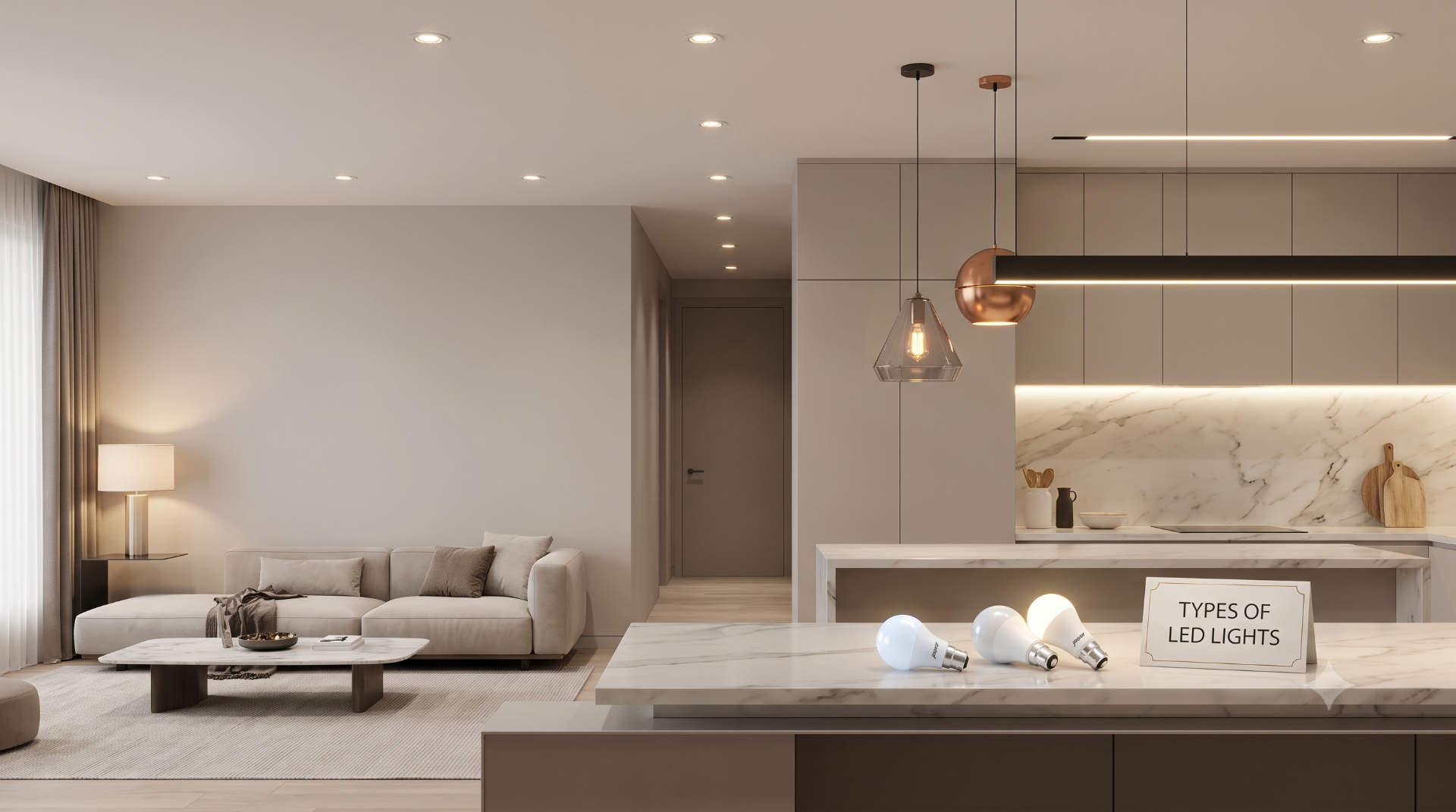
Choosing lighting becomes much easier when you stop looking at fixtures as individual products and start looking at them according to what they need to accomplish.
A kitchen needs clarity around work surfaces. A bedroom benefits from softer, more controlled illumination. A living room may need several layers because it serves different purposes throughout the day. A corridor requires consistent visibility, while a decorative fixture may be selected as much for its visual contribution as for its light.
LED technology supports all of these requirements through different fixture formats.
Jaquar Sri Lanka's lighting portfolio covers decorative, indoor and outdoor lighting, alongside consumer and smart-lighting categories.
Understanding types of LED lights therefore starts with understanding the role each format plays.
What Is LED Lighting?
LED means light-emitting diode. LEDs generate light through semiconductor technology and can be incorporated into fixtures ranging from compact bulbs to large panels and architectural linear systems.
This flexibility is one of the reasons LED lighting has become common across residential and commercial environments.
Instead of having to use one type of fixture everywhere, homeowners can choose a lighting format according to room size, ceiling construction, activity and desired atmosphere.
LED products are also available in different colour temperatures. Jaquar's lighting ranges include options across warm, neutral and cool white depending on the product.
1. LED Downlights
Downlights are among the most practical choices for contemporary interiors.
They direct illumination from the ceiling towards the room and can provide either general or more focused lighting depending on the fixture and arrangement.
Jaquar's Sri Lanka range includes LED downlight options in recessed and surface-mounted formats.
Suitable applications
Downlights can work well in:
- Living rooms
- Bedrooms
- Kitchens
- Corridors
- Offices
- Retail interiors
- Selected bathroom applications
A group of smaller downlights can often provide more balanced illumination than one oversized central fixture.
For example, a living room can use several ceiling positions to distribute light around seating areas instead of creating one intensely bright point in the middle.
2. LED Panel Lights
Panel lights provide broad illumination through a relatively slim fixture.
They are particularly useful in rooms where consistent general lighting is required.
Jaquar's Sri Lanka lighting portfolio identifies LED panels as part of its consumer lighting solutions.
Panels can be useful in:
- Bedrooms
- Kitchens
- Studies
- Offices
- Commercial spaces
- Multipurpose rooms
Their relatively clean appearance also makes them suitable for contemporary interiors where homeowners prefer a less visually prominent ceiling.
3. LED Bulbs
LED bulbs are useful when the fixture already exists and the light source itself needs to be upgraded.
They can be used with compatible:
- Table lamps
- Floor lamps
- Pendants
- Decorative fixtures
- General light fittings
This makes bulbs particularly useful for homeowners who want flexibility without changing an entire lighting installation.
The Jaquar lighting portfolio includes LED bulb solutions alongside other indoor lighting formats.
4. LED Batten Lights
Batten lights are linear fixtures designed primarily for practical illumination.
They are useful in spaces where broad visibility is required and decorative appearance is not necessarily the primary objective.
Potential applications include:
- Utility areas
- Kitchens
- Workspaces
- Garages
- Storage areas
- Offices
Jaquar's lighting range includes batten products such as Glaze and Kubik solutions.
Their linear form can also make them easy to align with the shape of a room.
5. LED Strip Lights
Strip lights introduce a different approach to lighting.
Rather than acting as a conventional standalone fixture, they can follow surfaces and architectural lines.
Jaquar's lighting portfolio includes LED strip lights and associated drivers, with options covering different colour temperatures and applications.
They can be used for:
Ceiling details
A concealed strip can provide indirect illumination around a ceiling feature.
Furniture
Selected cabinetry and furniture details can benefit from subtle linear illumination.
Wardrobes
Strip lighting can improve visibility in storage areas.
Decorative features
A strip can highlight a niche, recess or architectural line.
Strip lighting is particularly valuable when the light source itself is not intended to become the main visual feature.
6. LED Linear Lighting
Linear lighting creates a more defined architectural line than conventional point-based fixtures.
Jaquar offers linear lighting solutions designed for architectural and contemporary applications.
It can be particularly effective in:
- Offices
- Corridors
- Retail spaces
- Modern residences
- Hospitality interiors
- Architectural features
Linear lighting works especially well where the interior already contains strong geometric lines.
A long horizontal fixture can reinforce the proportions of a room, while a vertical arrangement can draw attention towards a wall or architectural feature.
7. LED Track and Magnetic Lighting
Track-based lighting is useful when several individual light sources need to be directed towards different parts of a room.
Magnetic systems add another level of flexibility by allowing compatible fixtures to be arranged along the track.
Jaquar's lighting portfolio includes magnetic lighting options with both diffused and focused formats.
This makes them useful for spaces that require adaptable illumination.
A living room, for instance, may need general illumination today but more emphasis on artwork or a particular wall after an interior redesign.
A flexible lighting system can accommodate changing requirements.
8. LED Spotlights
Spotlights are designed for emphasis.
They can direct light towards:
- Artwork
- Bookshelves
- Decorative walls
- Furniture
- Display areas
- Architectural details
The most important principle is restraint.
Spotlights are most effective when they create a hierarchy. If every object is equally highlighted, the eye has nowhere specific to focus.
9. Decorative LED Lighting
LED technology does not mean every light has to look purely functional.
Decorative lighting can become an important part of an interior.
Jaquar's broader lighting portfolio includes decorative formats such as pendants, wall lamps, table lamps and floor lamps.
A pendant can define a dining area. A floor lamp can create a reading corner. A table lamp can introduce a softer layer beside a sofa or bed.
In these applications, the appearance of the fixture and the quality of the illumination are equally relevant.
Choosing LED Lighting Room by Room
Living Room
Start with general illumination and add one or two secondary layers.
Downlights or panels can provide the base. Decorative pendants, wall lamps, floor lamps or selected spotlights can create additional atmosphere.
Bedroom
Comfort should be the priority.
Use general illumination with bedside table or wall lighting. Strip lighting can be useful for subtle architectural details.
Kitchen
Prioritise visibility.
General ceiling illumination should be supplemented wherever work surfaces need additional light.
Study or Home Office
Consistent general illumination helps create a comfortable work environment.
A panel or appropriate indoor fixture can provide the base layer, while task lighting can support the desk.
Corridor
Use evenly distributed lighting to avoid dark gaps.
Downlights and linear solutions can both work depending on the architecture.
Outdoor Spaces
Outdoor environments require fixtures suited to the intended location and environmental exposure.
Jaquar Sri Lanka also offers dedicated outdoor categories, including projectors and street-lighting solutions.
Warm, Neutral and Cool Light
Colour temperature affects perception.
Warm white
A warmer appearance can make bedrooms, lounges and dining spaces feel more relaxed.
Neutral white
Neutral illumination offers a balanced appearance and can work well in kitchens, studies and multipurpose spaces.
Cool white
Cooler illumination creates a crisp appearance and may be useful in work-oriented areas where visual clarity is important.
The correct choice depends on the room, its finishes and how it is used.
Watts vs Lumens
One of the most common mistakes when choosing LED lighting is focusing only on watts.
Watts indicate electrical power consumption.
Lumens indicate light output.
Therefore, selecting a fixture simply because it has a higher wattage does not necessarily mean it will provide the best illumination.
Instead, consider the amount of light required for the room and how that light needs to be distributed.
How Many LED Lights Does a Room Need?
There is no universal number.
A compact bedroom may need a general ceiling fixture plus bedside lighting.
A large living room may require several ceiling fixtures and additional decorative or accent lighting.
The number depends on:
- Room dimensions
- Ceiling height
- Wall colours
- Furniture arrangement
- Natural daylight
- Activity
- Desired atmosphere
- Fixture output and distribution
The objective should always be balanced illumination rather than maximum brightness.
How to Layer LED Lighting
A useful lighting plan can be divided into three layers.
Ambient lighting
This establishes the general level of illumination.
Panels and downlights are common examples.
Task lighting
This supports a particular activity.
Examples include focused lighting around work areas, reading areas and kitchen surfaces.
Accent lighting
This creates visual emphasis.
Strip lights, spotlights and selected decorative fixtures can perform this role.
The layers should complement each other rather than compete.
LED Lighting for Smaller Rooms
Small spaces benefit from restraint.
Too many fixtures can make a compact room feel visually crowded.
Recessed downlights can maintain a relatively clean ceiling appearance. Wall-mounted decorative fixtures can save surface space. Strip lighting can introduce a subtle architectural layer without requiring another large fixture.
In a small bedroom, for example, a compact ceiling fixture combined with bedside lighting may be more effective than several decorative lights.
LED Lighting for Larger Rooms
Large spaces require greater consideration of distribution.
A single central fixture can leave corners poorly illuminated.
Instead, divide the room into zones.
A living room might have:
- General ceiling lighting
- Sofa-area lighting
- Accent lighting
- Decorative lighting
This approach makes the room more adaptable.
Common LED Lighting Mistakes
Using one fixture type everywhere
Different rooms have different requirements.
Choosing by appearance alone
The fixture must provide suitable illumination for its intended purpose.
Over-lighting
More fixtures do not automatically produce a better result.
Ignoring colour temperature
A very cool light can change the character of a warm interior.
Forgetting glare
Comfort should remain a priority.
Mixing too many lighting styles
Fixtures should share a coherent relationship even when they are not identical.
Frequently Asked Questions
1. What are the main LED lighting options for a home?
Common options include downlights, panel lights, LED bulbs, battens, strip lights, linear fixtures, spotlights and decorative LED lighting.
2. Are LED panel lights suitable for homes?
Yes. Panels can provide broad, consistent general illumination and can work well in bedrooms, living areas, kitchens, studies and other spaces.
3. What are LED strip lights used for?
They are particularly useful for indirect illumination, architectural details, selected furniture, wardrobes, ceiling features and decorative applications.
4. Are LED downlights suitable for small rooms?
Yes. Their compact form makes them useful where homeowners want practical illumination without introducing a visually large ceiling fixture.
5. How do I select the right LED lighting for a room?
Consider the room's size, purpose, ceiling height, furniture, natural light and desired atmosphere. Then select the fixture format and light characteristics that support those requirements.
Conclusion
LED lighting is most effective when it is planned around how people actually use a space.
Downlights and panels can establish the general layer, bulbs and battens provide practical everyday options, strips and linear fixtures add architectural flexibility, while decorative fixtures can contribute both illumination and character.
Rather than selecting one lighting format for an entire home, consider each room individually and build a combination that supports its purpose.
Jaquar Sri Lanka's lighting portfolio spans indoor, decorative and outdoor solutions, giving homeowners and designers the flexibility to approach lighting according to the requirements of each space.